Antitrust Litigation
Various laws exist to ensure that people can compete in a free marketplace and that consumers have access to products and services. This is capitalism. When companies try to use their power to prevent competitors from offering better prices or products and force consumers to lose their power of choice, the law allows people disrupt that effort. But many people don’t think they are breaking the law when they do the kinds of things the law prohibits.
Why should you continue to read this post about antitrust litigation?
For too long, the FTC has dominated the market on antitrust information.
You’re a pro athlete who is upset about not getting drafted.
You just read a post about trust litigation and you want to balance it out.
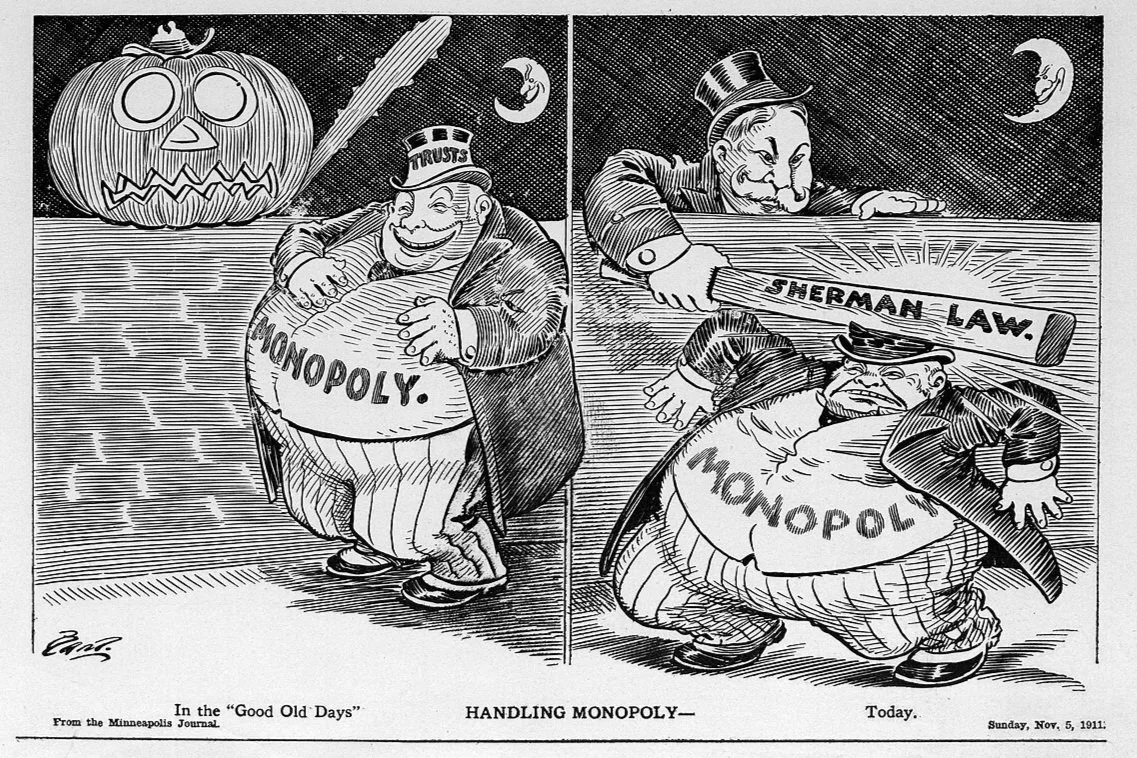
Bartholomew, Charles Lewis 'Bart', 1869-1949, Handling Monopoly - DPLA - 09bac79b018343ce1035c289a0fb575a, public domain, from Wikimedia Commons
Federal Law Prohibits Cartels and Monopolies
In the United States, the Sherman Antitrust Act prohibits anticompetitive agreements. Cartels use these structures. They dictate the price of a good so consumers can’t get a better price or agree with other cartel members to stay out of each other’s territories so consumers in those territories have only one source for the goods they want. Another classic illegal anticompetitive agreement is “bid rigging,” in which multiple people submit bids at agreed-upon prices so a process to select a winning bid looks like it was competitive, but there was only one possible winner.
The law prohibits any conduct that creates a monopoly. When a market-dominant company makes competition impractical but not impossible, this action can still violate the law. The company may have asked suppliers not to supply the company’s competitors. Or it may have engaged in “predatory pricing,” lowering prices below the cost of making them to drive smaller competitors out of business; once competition was out of the way, company could raise prices with impunity. Or a company may tie products together in such a way that no other company can compete with the included product. One such antitrust case involved Microsoft bundling its web browser, Internet Explorer, into its operating system, Windows.
Some conduct is illegal “per se,” which means it is always illegal. We don’t need to argue about the action’s effects for the defendant to lose. Agreeing to fix prices or refusing to sell to certain types of consumers both fit this definition.
But other conduct can still violate the law. Courts apply what they call the “rule of reason” to determine whether the defendants conduct is so unreasonably anticompetitive, given the particular circumstances, that it was illegal. In a prominent case, a court held that the NCAA’s rule prohibiting televising basketball games restricted the supply of viewers and thus “restrained trade or commerce.”
The FTC and Market Participants May Assert Antitrust Claims
Federal law allows the government to ensure antitrust law compliance by bringing claims against defendants. The Federal Trade Commission and the Antitrust Division of the Department of Justice both go to court to bring antitrust claims.
Additionally, a market participant who has suffered harm because of anticompetitive conduct may bring a claim in court, alleging a violation of the law. For example, a cigarette company once sued Brown & Williamson, alleging the large company sold cigarettes too cheaply for the smaller company to compete. In another example, a football player sued the NFL, alleging that its group boycott prevented him from playing professional football anywhere.
Measuring Damages
A challenge in antitrust cases is determining what the remedy should be for a violation. Many plaintiffs and the government seek an injunction, barring the conduct from happening. But many who have suffered financial losses seek damages.
The law allows plaintiffs to recover triple their losses, or treble damages, but it is not always easy to establish the amount of loss attributed to the anticompetitive conduct as opposed to more legitimate sources of market advantage.
Some scholars argue that the damages should be sufficient for deterrence, regardless of the harm to the plaintiff. Courts still require plaintiffs to establish damages, and many rely on expert witnesses to calculate the estimated amount.