Litigation in Lithuania
Lithuania is not just famous for beautiful castles, folk music, and farmhouse beer. It is also a technology capital, economic power, and home to about three million people. And so of course it is home to commercial disputes. I have long wanted to visit, but before I could, I had the opportunity to speak with Evaldas Pocevičius, a partner at TRINITI JUREX law firm in Vilnius, to learn more about litigation in Lithuania.
Why should you continue reading this post about litigation in Lithuania?
You already read my interview about litigation in Estonia and you want to learn more about Baltic dispute resolution.
You already read my interviews about litigation in Luxembourg and Liechtenstein and you want to learn more about European countries that start with the letter L.
One of Lithuania's three satellites has collided with yours and you want compensation.

Evaldas Pocevičius. Stay tuned: This post has legal robes!
photo credit: TRINITI JUREX
Evaldas Pocevičius is an Arbitration and Litigation partner at TRINITI JUREX law firm and a Board member at LitBAN, Lithuanian Business Angels Network, in Vilnius, Lithuania. This interview was lightly edited.
What kinds of disputes do you handle in your legal practice?
I head arbitration and cross-border disputes practice at TRINITI JUREX, so my playground is fairly broad — commercial litigation and arbitration. I deal with shareholder disputes, post-M&A conflicts, complex contract disputes, energy & infrastructure, insolvency and debt recovery, class actions, international disputes, and arbitration.
If it’s complicated, cross-border, and slightly uncomfortable for everyone involved, that’s when I get a call.
What type of clients do you generally represent in disputes?
Mostly medium to large businesses, or their owners (in shareholder disputes). I also represent energy companies, financial institutions, and start-up founders. Our firm may have the longest tenure in Lithuania of representing startups.
Besides Microsoft Office, what software do you use in your practice?
We all have a complicated relationship with Microsoft Word. Aside from that, I use NetDocuments for document management, CSI Lawyer for billing and client relationship management, DeepL for translations, and some PDF tools. Our other software are the usual suspects. Most recently, we have been using and testing various AI tools, carefully and responsibly — we’re lawyers after all, not gamblers.
Oh, and of course, Microsoft Outlook, the true battlefield of modern litigation.
What books and websites do you use for legal research?
For Lithuanian law we use private case law database INFOLEX and the official records of Lithuanian courts as well as a database of all statutory law. For international arbitration and comparative issues, we use different tools depending on the jurisdiction.
Do you electronically file pleadings with the court? Or must you send paper copies to the courthouse?
Everything is filed electronically now via the Lithuanian court system, and filling electronically is incentivized by a 25% reduction in court fees if the whole case is handled electronically. Therefore, paper copies are mostly a thing of the past, thankfully! Litigation paperwork used to double as weightlifting.
How many pages are the complaints or initial pleadings you usually see in your work?
It depends on the complexity, but the length has generally decreased within the last five years. Long submissions are rarely read in full. Initial pleadings in most litigation are around 8-12 pages. In arbitration, the pleadings are longer, generally around 20 pages for the initial request.

Supreme Administrative Court of Lithuania.
Pofka, CC BY-SA 4.0 <https://creativecommons.org/licenses/by-sa/4.0>, via Wikimedia Commons
How long does it take for a typical case to go from complaint to judgment?
In commercial litigation, you are likely to get a first instance court judgment within 12–18 months. The appeal, which is mostly done in writing, will take another 4-8 months. Cases admitted to the Supreme Court may spend another 6–12 months there.
Arbitration is usually faster. Vilnius Court of Commercial Arbitration usually awards a resolution in about seven months. This speed is one reason my arbitration practice is busy.
Does Lithuania have specialized courts that only hear commercial cases?
No. So especially if the claim value is low, your credit letter or securities case is likely to go to a county court. There, the same judge may hear a divorce case at 9 AM and your securities case at 1 PM.
Regional courts handle any case where value in dispute is above €100k. Those courts have more experience in commercial or business disputes, so the judges are well-equipped.
Who decides the facts in a commercial case? Is it a judge or a jury?
Always a judge. Lithuania does not use juries in any cases whatsoever.
How is evidence exchanged between the parties before trial? Do you get to interview opposing witnesses before the trial?
We don’t have the US-style discovery phase. Exchange of evidence only starts once the case is filed. Each party submits its own evidence with pleadings. Either party or the court itself may request that specific documents be produced.
There are no depositions, no pre-trial cross-examinations. So the first time you question the opposing witness is usually in the courtroom. This keeps things interesting! Testimony or witness statements in writing are generally not allowed, unless, for example, the witness has a prohibitive medical condition.
Lithuania regained its independence after the fall of the Soviet Union. What effect did this period have on the law that applies to commercial disputes?
After regaining its independence, Lithuania reformed its entire legal system, moving toward civil law tradition aligned with Continental Europe. Our private law has been a mixture of rules from Germany, France, and Netherlands. Since 2004 when Lithuania joined the EU, we not only adopted the regulations that apply to all member states, but we amended other laws to align with European principles.
Today, Lithuanian commercial law is European and modern. The Soviet legacy is more of a historical chapter than an influence on current disputes.
Does the losing party in a litigation pay the legal fees of the winning party?
Yes, generally the “loser pays” principle applies.
However, only reasonable and proportionate legal costs are awarded, and courts often reduce claimed legal fees. In the last few years, the average recoverable amount has increased, but usually you will not recover every cent you spent drafting 70-page pleadings at 2 AM.
Are Lithuanian courts open to the public?
Yes, hearings are generally public unless they involve state secrets, confidential business information or excessive personal data. Parties may argue for closed hearings, but the standard of getting a hearing behind closed doors is considerably high. The public’s right to know is protected.
So, in theory, yes — anyone can walk in and observe a case. In practice, commercial hearings rarely attract an audience unless it’s a high-profile, politically interesting dispute.
Do Lithuanian courts have a strength for resolving commercial disputes?
Upper-court judges are professional and knowledgeable. You can predict they will apply the law properly and follow Supreme Court guidance. Efficiency and the low costs of court proceedings are the main advantages why one should consider Lithuania as the venue for cross-border disputes.
What are their weaknesses?
There are, obviously, weaknesses in any country and room for improvement. I would focus on sanctions for parties not complying with court orders to produce evidence. We may also consider changing the way preliminary hearings are being used, such that cases are managed more efficiently, similar to arbitration. Judges could also be a little more business-minded in commercial cases. There should be an awareness of potential business outcomes in addition to the purely legal view.
That said, for a small country, Lithuania’s commercial dispute system functions remarkably well!
How often do you go to the courthouse? When you are there, do you need to wear a special robe or wig?
These days, it’s less often. Many hearings are remote. I prefer that preliminary hearings be remote, but old-school, face-to-face hearings are better for pleadings and witness examination. In active litigation periods, I might be in court several times a month, up to five days a week, but generally, I visit the court about five times a month.
Attorneys, judges, and prosecutors are required to wear robes in court — but no wigs, thankfully.
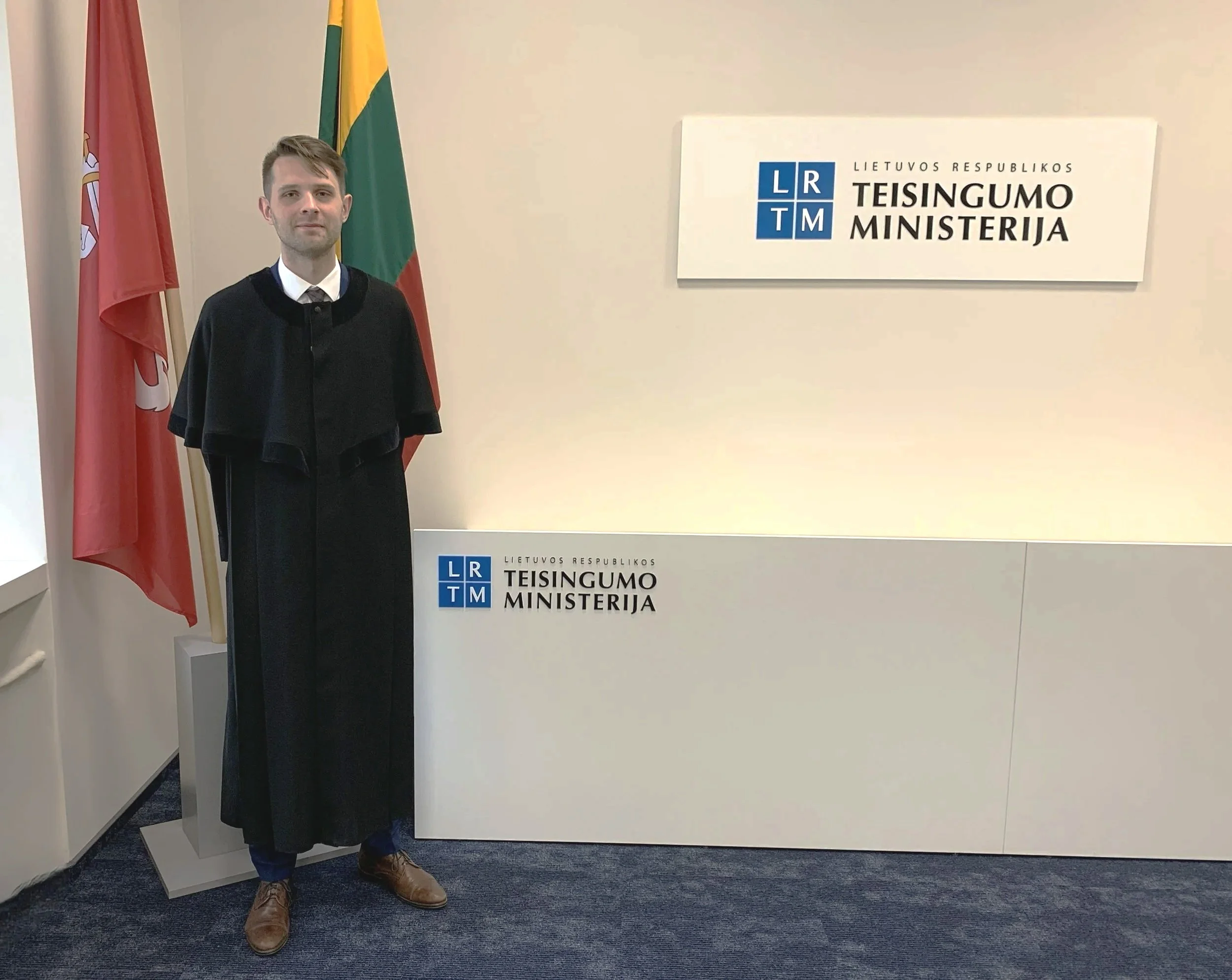
Evaldas Pocevičius on the day he was sworn in, 2020.