Litigation in Bangladesh
Bangladesh is one of most populous countries on Earth and it has one of Southeast Asia’s largest economies. And where there are people and economies, there are commercial disputes. I wanted to learn what commercial litigation was like in Bangladesh, but, unfortunately, there are no nonstop flights from New York to Dhaka, and I’m too old for layovers. So until I can charter a plane or yacht, I needed some help. Luckily. Sayeed Abdullah Al Mamun Khan, a partner at A.S. & Associates in Dhaka, was kind enough to tell me about his litigation practice. Special thanks go to Ferdaus Rahman, CEO of the firm, for referring me to Sayeed.
Why should you continue reading this post about litigation in Bangladesh?

Photo credit: A.S. & Associates.
Sayeed Abdullah Al Mamun Khan is a partner and Litigation & Dispute Resolution practice lead at A.S. & Associates, a law firm based in Dhaka. This interview was lightly edited.
Can you tell me about the kinds of disputes you handle in your legal practice?
Being a full-service law firm, our practice encompasses a broad spectrum of domestic and cross-border disputes, with a particular focus on commercial and corporate litigation. We regularly advise and represent clients in contractual and transactional disputes, company and shareholder disputes, banking and financial matters, loan recovery proceedings, construction and infrastructure related project disputes, and employment and labour-related matters. Our practice also extends to admiralty, civil and criminal litigation, land and property disputes, tax and VAT disputes, intellectual property disputes, and matters involving administrative and constitutional law. Often project disputes require us to rely on writ jurisdiction to challenge executive orders and decisions for protecting interests of the clients.
Our corporate practice provides a platform for identifying and addressing potential disputes arising from corporate transactions, commercial arrangements, and regulatory matters. In addition to litigation, we deal with alternative dispute resolution, including domestic and international arbitration, mediation, and negotiated settlements.
What type of clients do you generally represent in disputes?
We primarily represent institutional and corporate clients, including foreign investors, multinational corporations, commercial banks, non-banking financial institutions (NBFIs), JV entities, project SPVs, and domestic business groups of varying sizes, particularly those operating in the real estate, infrastructure, and energy sectors. We also advise and represent property developers, housing societies, construction companies, research institutions, high-net-worth individuals, and individual clients in a range of legal matters. In essence, our corporate clients rely on us for addressing all types of their dispute issues.
What software do you use in your practice?
We use online legal research platforms, digital case-law databases, and relevant government portals to support legal research, monitor cases, and verify applicable laws and regulatory requirements in Bangladesh. We are exploring the use of AI tools to improve efficiency in specific tasks, such as summarizing legal materials, conducting preliminary research, and assisting with drafting. However, we place considerable importance on professional judgment and independent verification, and any AI-assisted output is carefully reviewed and verified in due process for accuracy and protecting client confidentiality.
What books and websites do you use for legal research?
We use a combination of our firm’s extensive in-house legal library, online legal research platforms, and authoritative law reports. One of our most valuable assets is our comprehensive collection of legal books and reference materials covering Bangladesh law as well as the laws of various other jurisdictions, which is particularly useful for cross-border transactions and comparative legal research.
For online research, we use BDLaws, the official legislative portal maintained by the Ministry of Law, Justice and Parliamentary Affairs, as well as premium legal research platforms such as Manupatra. We regularly refer to the Dhaka Law Reports (DLR), Bangladesh Legal Decisions (BLD), and Mainstream Law Reports (MLR). Where relevant, we use the Supreme Court of Bangladesh’s official online database of judgments to locate and review relevant judicial precedents and decisions of the Appellate Division and the High Court Division. Depending on the nature of the matter, we may refer to the websites of relevant regulators, government authorities, and international legal institutions to ensure that our advice is accurate and up to date.
Do you electronically file pleadings, or must you send paper copies to the courthouse?
Court pleadings are filed in hard copy at the filing counter of the relevant court or the filing section of the Supreme Court, together with the prescribed court fees, Wokalatnama (authorisation for an advocate to appear and act on behalf of a party), and the necessary supporting documents and affidavits. Few years ago, electronic filing arrangements were introduced for company matters before the Hon’ble High Court Division. Accordingly, the Court made a designated email address available to lawyers for filing company matters electronically. Under that arrangement, we scanned the complete petition and supporting documents and submitted them by email. However, this process has not operated consistently in recent times. Nowadays, we generally file pleadings in hard copy, and the applicable filing procedure may vary depending on the directions of the relevant court.
Although Bangladesh has not yet established a uniformly implemented, nationwide electronic filing system for all court proceedings, the judicial system is gradually embracing digitalization. Online cause lists are available, electronic bail-bond management has been introduced in some districts, and e-family courts are operating in pilot districts. The 2026 amendment to the Code of Civil Procedure allows summons to be served by SMS, voice call, or instant messaging. The Commercial Court Act 2026 goes further for commercial cases; it says that filing, summons, submission of documents, and pronouncement of judgment may be done electronically, subject to the infrastructure provided by the government and the Supreme Court's practice directions. The practical implementation of these facilities remains dependent on the relevant arrangements being established by the Government and the Supreme Court. We are optimistic that, with continued institutional support and the necessary technological infrastructure, Bangladesh will make further progress towards a more comprehensive digital court system.
How long does it take for a case to go from complaint to judgment?
It is impossible to provide a reliable answer, even with a range. Delays remain one of the principal concerns within the litigation system in Bangladesh. The duration of formal litigation is often prolonged due to systemic case backlogs. A standard commercial dispute before the civil courts from the filing of the plaint to the final judgment may take approximately three to five years.
Where the matter proceeds through appeals before the Hon’ble High Court Division and subsequently the Honorable Appellate Division of the Supreme Court of Bangladesh, the entire process may extend beyond a decade. To address these challenges, the government has introduced procedural reforms to facilitate digital practices, including the electronic service of summons and the online recording of testimony, with the objective of reducing delays. There is an increasing emphasis on mediation and court-annexed Alternative Dispute Resolution (ADR), with the aim of resolving suitable disputes without the need for protracted trials. However, until more judges are appointed and active case-management system is not introduced, the procedural legal provisions adopted primarily during colonial period will continue to produce extremely slow output for litigation system in the country
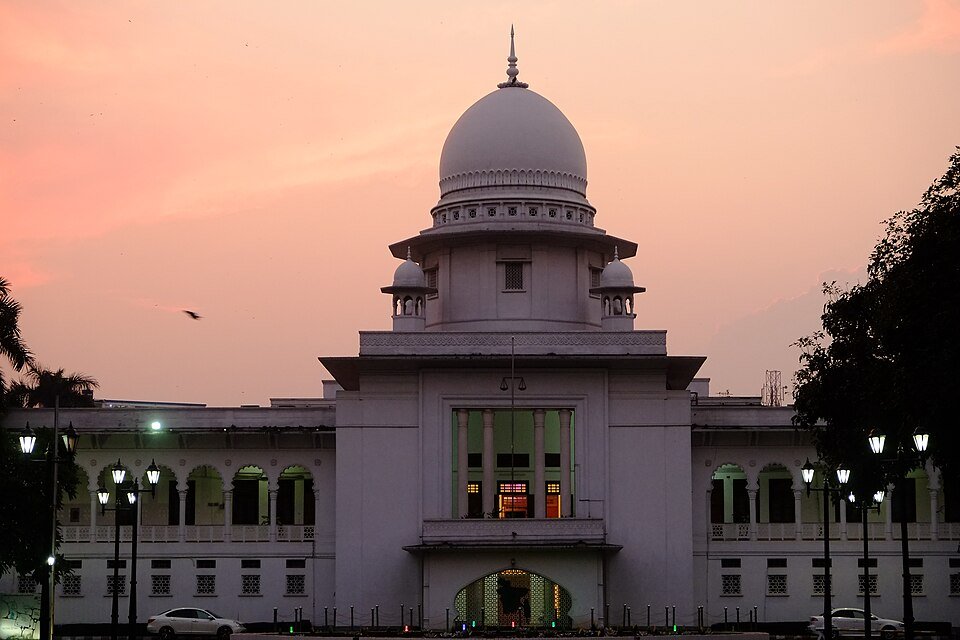
Photo credit: Supreme Ct., People’s Republic of Bangladesh 06, MD SAIFUL AMIN , CC BY-SA 4.0, 2018.
Does Bangladesh have specialized courts that only hear commercial cases?
Yes, these courts were established this year under the Commercial Court Act. The government has established 75 specialized courts across various districts and metropolitan areas to expedite commercial disputes. Within their territorial limits, they have exclusive jurisdiction over defined “commercial disputes.” Furthermore, for specialized matters related to recovery of loan from financial institutes, there is dedicated Money Loan Court and within the High Court Division of the Supreme Court of Bangladesh, dedicated specialized bench for admiralty and company matters are available.
Who decides the facts in a commercial case—a judge or a jury?
The jury system does not exist in Bangladesh. For commercial litigation, all questions of fact and law are determined exclusively by a sitting Judge appointed from the Bangladesh Judicial Service (District Judges or Additional District Judges), and, on appeal, by a Commercial Appellate Bench of the High Court Division. This is the fact for other specialized courts as well.
The judge examines the evidence presented by both parties, identifies the key factual and legal issues, and determines whether the dispute can be resolved through documentary evidence alone or whether oral evidence from witnesses is necessary. Where witness testimony is required, the judge assesses that evidence, including through cross-examination, before reaching a decision. Ultimately, the judge evaluates the evidence, determines the facts of the case, applies the relevant law, and delivers the judgment.
How is evidence exchanged between the parties before trial? Do you get to interview opposing witnesses before the trial?
The exchange and disclosure of evidence before trial is governed primarily by the Code of Civil Procedure, 1908, and the applicable procedural rules. In civil proceedings, the process generally involves the exchange of pleadings, disclosure and production of relevant documents, and inspection of documents where appropriate. The court may permit written interrogatories and make orders for discovery or production of documents, subject to the applicable procedural requirements.
Unlike other jurisdictions, Bangladesh does not generally follow a broad pre-trial discovery process involving depositions of opposing parties or witnesses. Accordingly, lawyers cannot to interview or depose opposing witnesses before trial as part of court-supervised discovery. Instead, witnesses are generally examined and cross-examined during the evidentiary stage of the proceedings, subject to the applicable rules of evidence and procedure.
What kinds of cases end up in Cyber Tribunals, and how do those courts differ?
Cyber Tribunals in Bangladesh are specialized criminal courts established to try offences falling within their statutory jurisdiction under the new Cyber Security Act. Such cases may include hacking, data theft, cyber fraud, digital forgery, unlawful electronic transactions, cyber-related extortion, and other crimes involving digital devices. Further, appeals against the judgments passed by the Cyber Tribunal lie with the Cyber Appellate Tribunal, a three-member panel led by a Supreme Court Judge.
The main difference is that an ordinary criminal court deals with a broad range of criminal offences, whereas a Cyber Tribunal focuses on offences falling within its statutory jurisdiction. It is presided over by a judicial officer and follows the applicable criminal procedure, but its cases often require consideration of digital evidence, electronic records and technical evidence relating to computer systems or online activity. Furthermore, the tribunal exercises extraterritorial jurisdiction, allowing it to try cross-border offenses initiated outside Bangladesh that impact domestic networks, and operates alongside the National Cyber Security Agency to review and validate the immediate blocking or removal of harmful online content.
How has the Virtual Court Act changed commercial disputes?
The Use of Information and Communication Technology by Courts Act, 2020, commonly known as the Virtual Court Act, was introduced during the COVID-19 pandemic and established a legal framework for conducting judicial proceedings through virtual means. It enables courts to conduct hearings, receive evidence, hear arguments, and deliver orders and judgments through audio-visual or other electronic means, subject to applicable practice directions.
In our experience, virtual proceedings have provided greater flexibility in representing clients, particularly where physical attendance is difficult or impractical. They can help reduce travel time and associated costs, facilitate participation by clients and lawyers in different locations, and improve access to certain court proceedings. However, the extent to which virtual hearings are available in practice depends on the relevant court's arrangements and applicable directions.
More recently, the Commercial Court Act of 2026 has expressly permitted all types of commercial court hearings to be conducted virtually. It provides for activities such as filing suits, serving summons, submitting documents, and publishing judgments to be carried out electronically, subject to the infrastructure and compliance with Supreme Court practice rules.
We see these developments as an important step towards modernizing dispute resolution in Bangladesh. Nevertheless, the effectiveness of virtual proceedings will depend on consistent implementation, adequate technological infrastructure, and clear procedural guidelines.
Do other legal traditions that govern how Bangladeshi courts decide commercial disputes?
Although our legal system is substantially influenced by English common law, decisions from India and to some extent Pakistan have strong persuasive authority. They are often cited by lawyers and judges. Generally speaking, Bangladeshi courts apply a combination of statutory law, judicial precedents, precedents from India, Pakistan and England and relevant procedural and evidentiary rules.
Similarly, commercial disputes are primarily governed by domestic legislation, including the Contract Act, 1872, the Sale of Goods Act, 1930, the Companies Act, 1994, and the Arbitration Act, 2001, among other applicable laws. Islamic legal principles may be relevant in matters where personal law (family or succession matters) or Shariah-compliant financial arrangements are concerned.
In cross-border commercial disputes, we look at international conventions, contractual choice-of-law provisions, and international principles of arbitration, subject to their recognition under Bangladesh law. Ultimately, the approach taken by the courts depends on the nature of the dispute, governing legislation, the terms of the relevant contract, and applicable judicial precedents.
Does the losing party in a litigation pay the legal fees of the winning party?
While the procedural law has provisions empowering the courts to order at its discretion payment of legal fees of the winning party by the losing party or to order any other cost sanctions, in reality, such orders are hardly practiced—even for obvious meritless proceedings drawn in abuse of process. In rare instances when such cost order is issued, the order does not necessarily cover the winning party’s actual legal fees in full. It’s merely a token sanction.
Are Bangladeshi courts open to the public?
Yes. As a general rule, court proceedings in Bangladesh are open to the public. Ordinary members of the public may attend hearings, including commercial trials, subject to the availability of space and any restrictions imposed by the court. Under section 352 of the Code of Criminal Procedure, 1898, a court is generally required to be open to the public, although the presiding judge or magistrate may restrict public access where appropriate. In certain cases, involving sensitive information, personal privacy, or other exceptional circumstances, the court may direct that proceedings be held in camera (i.e., in private, with public access restricted). For example, this may arise in proceedings involving juveniles, sexual offences, domestic violence, or other matters where protecting privacy or confidentiality is considered necessary. Such restrictions are exceptions to the general principle of open court proceedings.
Accordingly, members of the public can generally observe ordinary commercial proceedings unless the court directs otherwise. Additionally, certain proceedings may be conducted virtually where permitted by applicable law and the relevant court's directions.
Do Bangladeshi courts have a strength for resolving commercial disputes?
The Bangladeshi judicial system, particularly at Supreme court level, both at the High Court Division and at the Appellate level, has considerable capabilities for resolving commercial disputes. However, inadequate number of judges at the Supreme Court level makes the strength having real impact and often commercial disputes take much longer than to have commercial meaning.
Within the lower judiciary system, the strength is lacking in our opinion, especially for complex commercial, transactional and financial disputes. There is pressing need for capacity building, specialized training for commercial matters and appointing specialized judges with relevant experience for addressing commercial disputes in a commercially viable timeline.
In our opinion, availability of the specialized forums, including the Artha Rin Adalat (Money Loan Courts) for loan recovery, the Company Bench for company-related matters and the Admiralty Court for maritime disputes, along with recently formed commercial court under the Commercial Court Act 2026 are significant development towards right direction, introducing a more structured framework for commercial litigation through case management, restrictions on adjournments, time-bound hearings, mediation and provisions concerning costs and interest, however, for proper utilization of these systemic strengths, it is imperative that dedicated training for judges and increasing the number of judges are prioritized.
What are their weaknesses?
Delay remains the principal weakness of the Bangladeshi judicial system. Case backlogs are substantial, and adjournments are common and can sometimes be obtained without sufficient justification. Courts tend to be lenient in granting adjournments, which parties may take advantage of to prolong proceedings. The service of summons is another significant challenge, particularly in civil suits, as proceedings generally cannot progress until summons has been duly served. Moreover, statutory timelines prescribed under the relevant laws, such as those for filing written statements, are not always strictly complied with in practice. In addition, the judicial system remains largely paper-based, while electronic filing and modern case-management systems are still under development. Hence, greater use of technology, more efficient case management, and wider adoption of alternative dispute resolution could help address these challenges and improve the overall efficiency of commercial dispute resolution in Bangladesh.
How often do you go to the courthouse? Do you need to wear a special robe or wig?
We attend court regularly, often on a daily basis, depending on the cause lists and the matters requiring hearings or other procedural steps.
Regarding court attire, wigs are not worn by lawyers in Bangladesh. The traditional dress generally consists of a black coat and gown, a white shirt, and white neck bands, in accordance with the applicable dress requirements of the relevant court.